
What Does “Business Marketing” Actually Mean?
If you ask ten small business owners to define business marketing, you’ll likely get ten different answers. Some say it’s “advertising.” Others say it’s “social media.” A few will say it’s “whatever gets the phone to ring.” All of them are partly right — and that’s exactly why the term causes so much confusion.
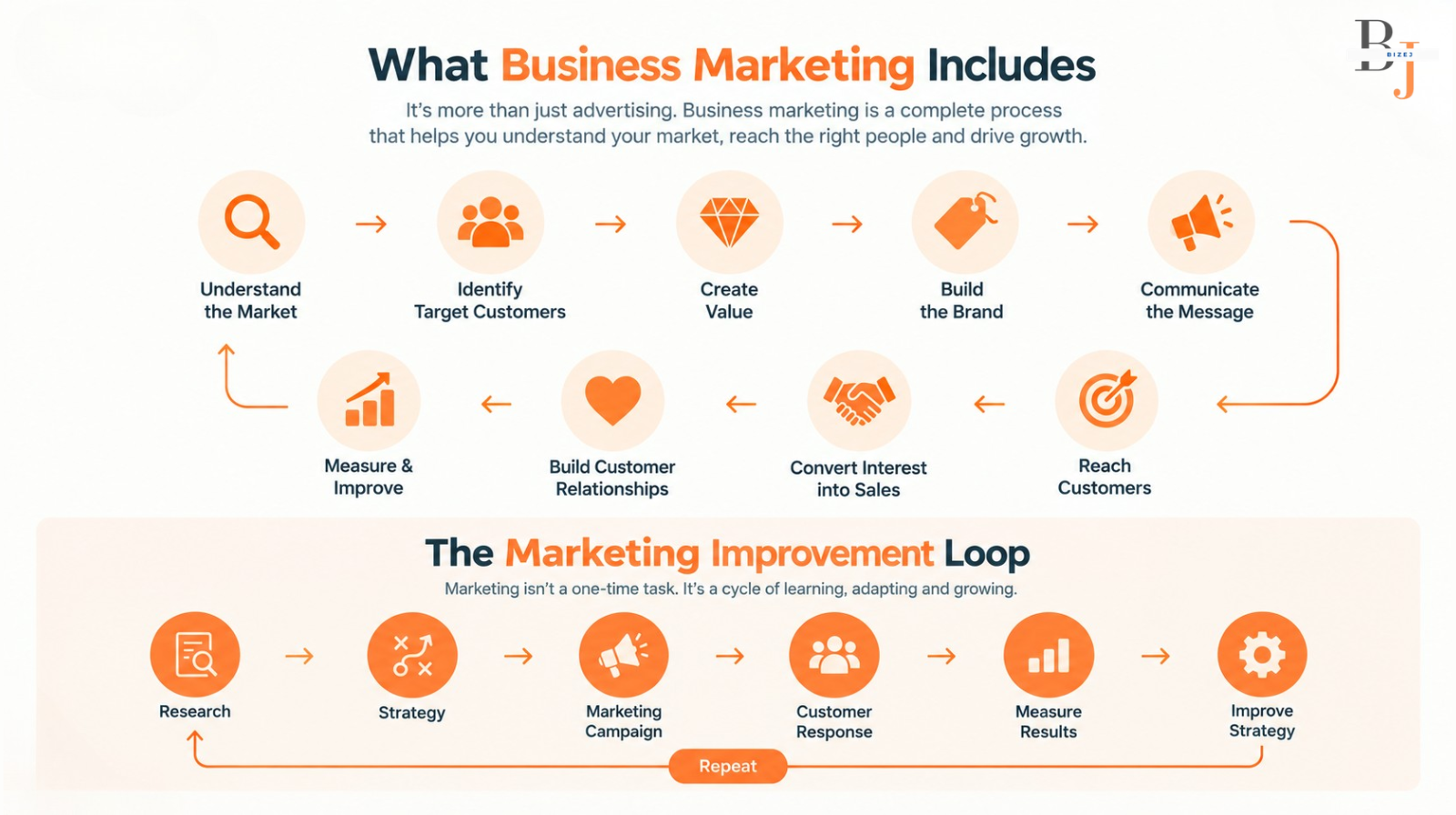
Business marketing is bigger than a Facebook ad or a flyer. It’s the entire system a company uses to understand its customers, create value for them, and turn that value into sustainable growth. Understanding what business marketing actually means — and what it doesn’t — is the first step to building a strategy that works instead of a pile of disconnected tactics.
The Real Definition of Business Marketing
According to the American Marketing Association (AMA), the leading professional body for marketers, marketing is “the activity, set of institutions, and processes for creating, communicating, delivering, and exchanging offerings that have value for customers, clients, partners, and society at large.” In other words, marketing isn’t one action — it’s an ongoing process built from research, strategy, execution, and measurement.
Management thinker Peter Drucker put it more simply: marketing is “the whole business seen from the customer’s point of view.” That distinction matters. Business marketing isn’t a department that gets added on after a product is built — it’s a lens through which every business decision, from pricing to packaging to customer service, should be viewed.
For small businesses specifically, this means marketing starts long before the first ad is published. It starts with a genuine understanding of who your customer is, what problem they have, and why your business is the right one to solve it.
Business Marketing vs. Advertising vs. Sales
One of the biggest sources of confusion is treating “marketing,” “advertising,” and “sales” as interchangeable terms. They’re related, but they are not the same thing:
- Marketing is the strategy — identifying your target market, shaping your brand, and deciding how to reach and retain customers.
- Advertising is one tactic within marketing — paid promotion designed to build awareness or drive action (think Google Ads or a boosted Instagram post).
- Sales is what happens after marketing has done its job — converting an interested lead into a paying customer.
Think of it this way: marketing builds the bridge between your business and your customer; advertising is one of the vehicles that crosses it; sales is what happens once the customer arrives on the other side. A business that only “advertises” without a marketing strategy behind it is often just spending money without direction — which is why so many small businesses feel like their marketing “isn’t working,” when really, they never had a strategy to begin with.
The Building Blocks: The Marketing Mix (4 Ps)
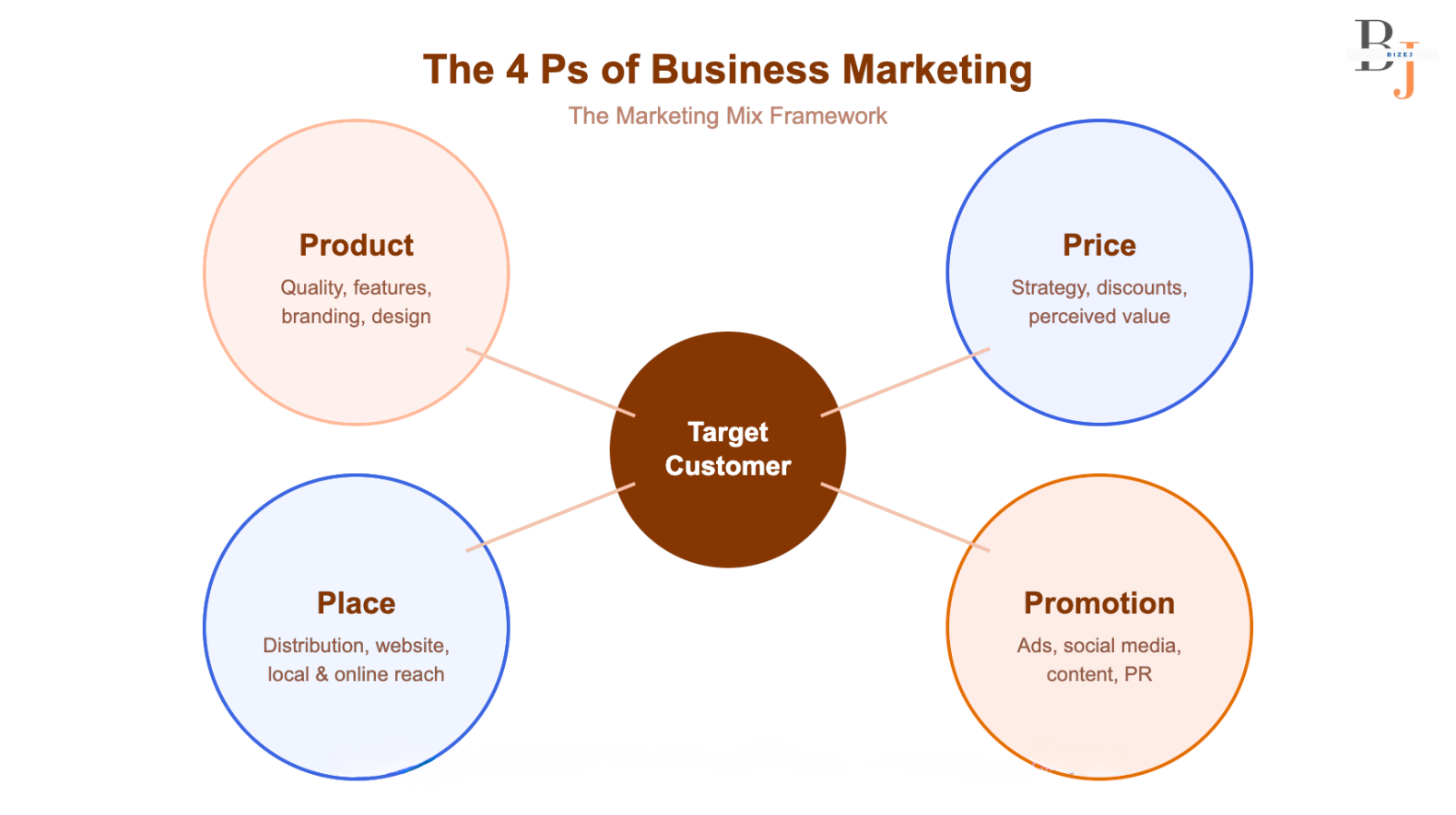
Once you understand marketing as a strategic process, the next question is: what actually goes into it? Marketing professor E. Jerome McCarthy introduced a framework in the 1960s — later popularized by Philip Kotler — known as the 4 Ps of Marketing, or the marketing mix. These four levers are still the foundation of nearly every modern marketing plan:
- Product — What you’re offering, and how well it solves your customer’s problem.
- Price — What customers pay, and how that price reflects the value they perceive.
- Place — Where and how customers can access your product, from a physical storefront to your website.
- Promotion — How you communicate your value: advertising, content, social media, and public relations.
Every successful marketing plan is really just a business making deliberate decisions about these four elements — instead of guessing. This is also where many small businesses trip up: they focus heavily on Promotion (posting on social media, running ads) while neglecting Product, Price, or Place, which throws the whole mix out of balance.
The Business Marketing Process, Step by Step
Business marketing isn’t a single event — it’s a cycle. The U.S. Small Business Administration’s Marketing 101 framework breaks the process into four repeatable stages, and understanding this flow is what separates businesses that grow steadily from those that burn budget on random tactics.
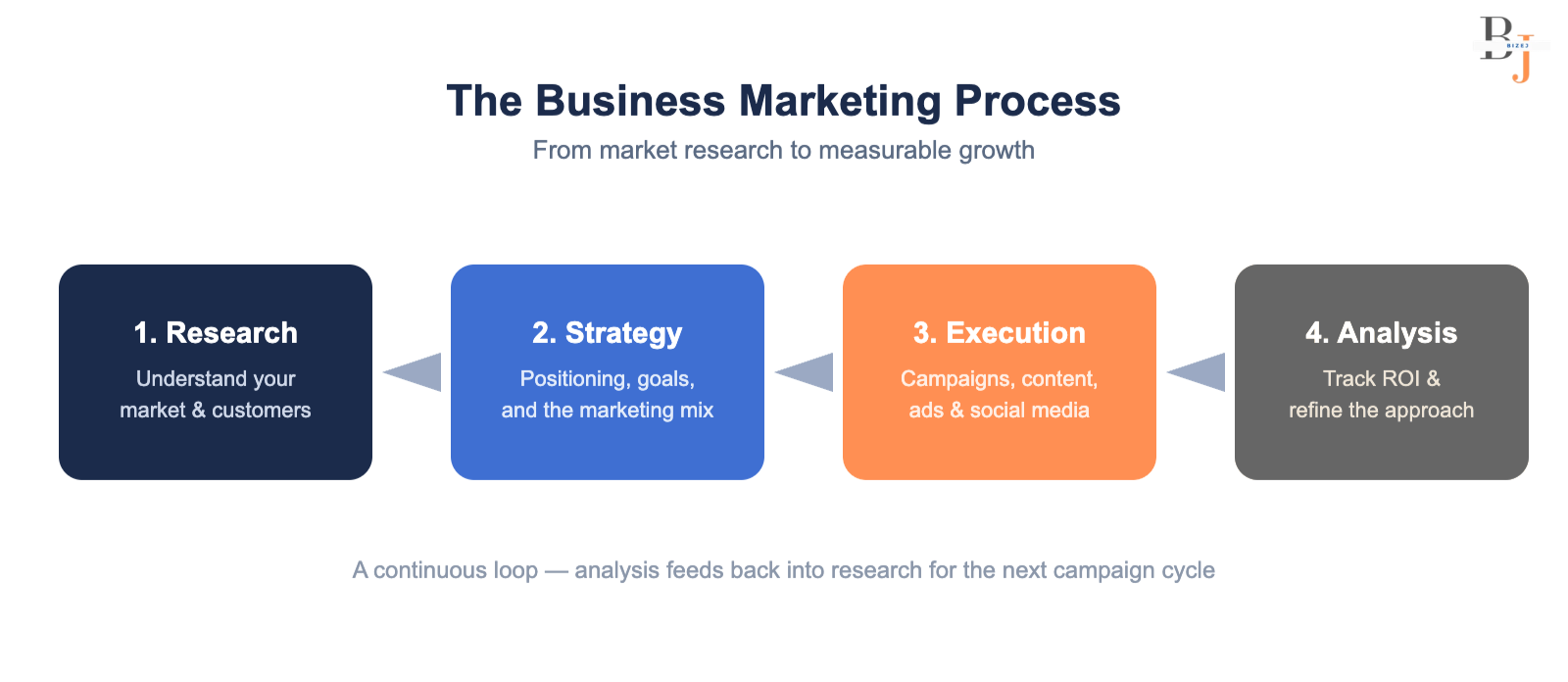
- Research — Study your target market, competitors, and industry trends before spending a dollar on promotion.
- Strategy — Define your positioning, goals, and how you’ll apply the 4 Ps to reach your ideal customer.
- Execution — Launch your campaigns: content, ads, email, social media, and more.
- Analysis — Track performance, measure ROI, and use those insights to refine the next cycle.
This loop is continuous. Markets shift, competitors change, and customer behavior evolves — which is why the businesses that treat marketing as an ongoing process (rather than a one-time project) are the ones that consistently outperform their competitors. In fact, staying current matters more than ever, and keeping an eye on the marketing trends shaping the year ahead can help you adjust your strategy before your competitors do.
Why This Matters More for Small Businesses
Larger corporations can absorb the cost of a marketing misstep. Small businesses usually can’t. Every dollar spent on the wrong channel or the wrong message is a dollar that didn’t go toward payroll, inventory, or growth. That’s precisely why treating business marketing as a strategic process — not just a checklist of tactics — is so important for small and local businesses.
A well-run marketing process helps small businesses:
- Attract the right customers, instead of casting a wide, expensive net.
- Build a recognizable brand that earns trust over time.
- Compete with larger players by being sharper and more targeted, not by outspending them.
- Make informed decisions, using real data instead of guesswork.
This is also where specific tactics earn their place within a broader strategy. For example, Google Ads can be a powerful tool for small businesses — but only when it’s built on top of clear positioning and a defined target audience, not used as a substitute for one. The same is true of seasonal campaigns; a well-timed push, like the ideas covered in Valentine’s Day marketing for small businesses, works because it’s grounded in an understanding of the customer, not because the calendar says so.
Bringing It All Together
So, what does “business marketing” actually mean? It means:
- Understanding your customer before you try to reach them.
- Making deliberate decisions about your product, price, place, and promotion.
- Treating marketing as a continuous process of research, strategy, execution, and analysis — not a one-off campaign.
- Recognizing that advertising and sales are important parts of the picture, but they are not the whole picture.
For small business owners, this reframing is genuinely freeing. It means you don’t need a massive budget to “do marketing right” — you need a clear strategy, a real understanding of your customer, and the discipline to keep refining your approach.
Let Bizej Help You Build a Marketing Strategy That Works
At Bizej, we specialize in helping small businesses turn the idea of “business marketing” into an actual, working strategy — from market research and brand positioning to social media management and ad campaigns. If you’re ready to move beyond guesswork, explore our services or get in touch to talk about a marketing plan built around your business goals.